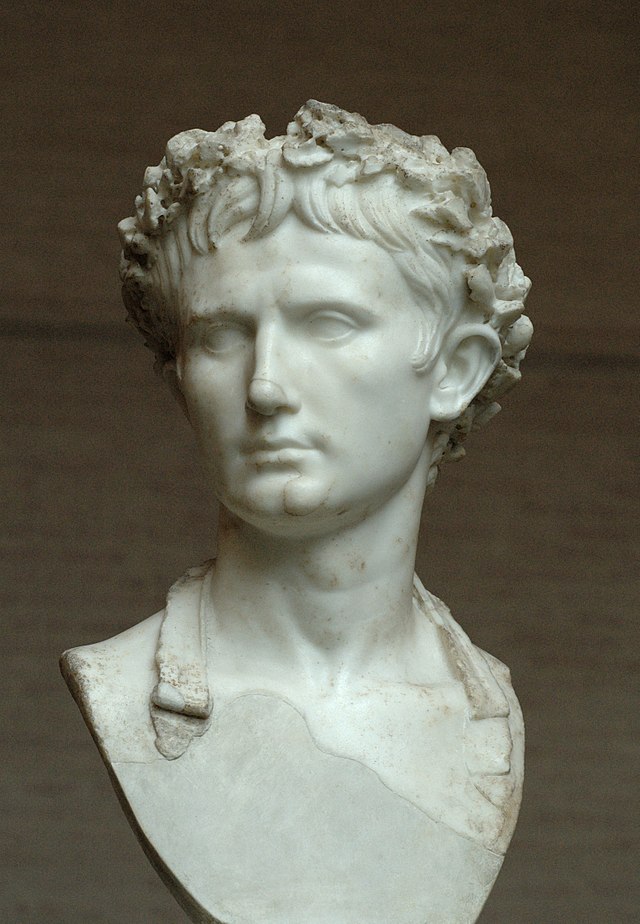
I wanted to begin my blog with the founder and arguably the greatest emperor of Rome, Augustus. His reign marked the dawn of the Pax Romana, a period of unparalleled peace and prosperity that spanned two centuries, despite brief interruptions like the Year of the Four Emperors following Nero’s assassination in 68 AD. Augustus was not just a ruler, his name became synonymous with nobility, authority, and the very essence of Roman stability. Starting with Augustus is fitting, as his leadership not only defined an era but also set the standard for Roman emperors to come.
In today’s blog, I will discuss the events and circumstances that led to Octavian’s rise to power, notably his adoption by Julius Caesar following his assassination, his efforts to avenge his adoptive father’s death, and the civil war with Mark Antony (“Antony”). Finally, I will examine how these events culminated in Octavian securing his position as the undisputed ruler of Rome in 27 BC.
Early years
Gaius Octavius, more commonly known as Augustus, or Octavian was born in September 23, 63 BC into the gens (family) Julia. The gens Julia was a prominent and ancient family in Roman politics, and claimed descent from the gods. His father was the first of the family to climb the Roman political hierarchy and become senator, and was eventually elected to the praetorship in 61 BC. He met his untimely death soon after at the age of 41 when Octavian was only 4 years of age. At age 12, Octavian’s great uncle Julius Caesar introduced him to the public, when Octavian delivered his grandmother Julia’s funeral speech. While Caesar became the chief priest, Pontifex Maximus, Octavian was made pontifices, a member of the board of Roman Priests in 47 BC, a significant religious role that further integrated him into the Roman public sphere. Octavian spent the following years in Caesar’s orbit, accompanying him in campaigns, such as the African one, where Caesar celebrated his victory over the remnants of the Pompeian faction, ending the civil war. These years spent alongside Caesar allowed him to admire Octavian’s potential and grow fond of him, eventually leading to his decision to adopt Octavian as his sole heir.
The aftermath of Caesar’s assassination

Julius Caesar was assassinated in 44 BC in the senate hall. The conspiracy led by Cassius and Brutus, was eventually joined by 60 senators. The senators claimed to be the “liberators” of the republic, who saved the people from a cruel tyrant that was aspiring to be king, a word that carried very negative connotations in the republic. Rome was originally a monarchy until 509 BC, when the actions of a prince, who raped the noblewoman Lucretia, sparked outrage and led to the monarchy’s overthrow. Her tragic fate sparked a revolt that would forever change Roman history, leading to the foundation of the Republic. The plan however backfired, due to Caesar’s popularity among the people of Rome because of the peace and stability he had brought after a long period of civil war. Following the assassination, the Caesarian faction consisting of Antony, a very able general and veteran, and Lepidus agreed to spare the lives of the liberators, if all of Caesar’s laws were ratified, and his will was read in public. Upon hearing the will, the people turned on the liberators, and erupted into chaos, and forced the liberators to flee. Antony was now the master of Rome, but not for long. Other claimants would soon arise, fighting for power and control. Civil war was on the horizon.
Adoption By Julius Caesar
In his will, Caesar named Octavian as his adoptive son and sole heir, and left him all of his belongings, due to him being his closest male heir, and his recognition of the young man’s potential. Octavian was only 19 at the time, and lacked the experience and power needed to take Caesar’s place, but despite his youthfulness and inexperience, his political instincts helped him navigate the treacherous waters of Roman politics. Octavian was training with Caesar’s legions in Illyricum when he heard of his adoption, and travelled to Brundisivm where crowds and veterans flocked to him and greeted him as Caesar’s son. Upon reaching Rome however, he was opposed by Antony, who prolonged his adoption, and spent a significant portion of Caesar’s wealth in the process. Octavian sold all his properties in order to pay the donatives that Caesar promised the people of Rome, 75 drachmae per citizen. Acquiring the funds proved to be a significant challenge, and demonstrated Octavian’s resourcefulness and determination. As a result the payment was seen not as a final gift from Caesar, but as a personal gesture from Octavian himself. This not only fulfilled his adoptive father’s promise, but also earned him immense popularity among the people.
The Battle of Mutina
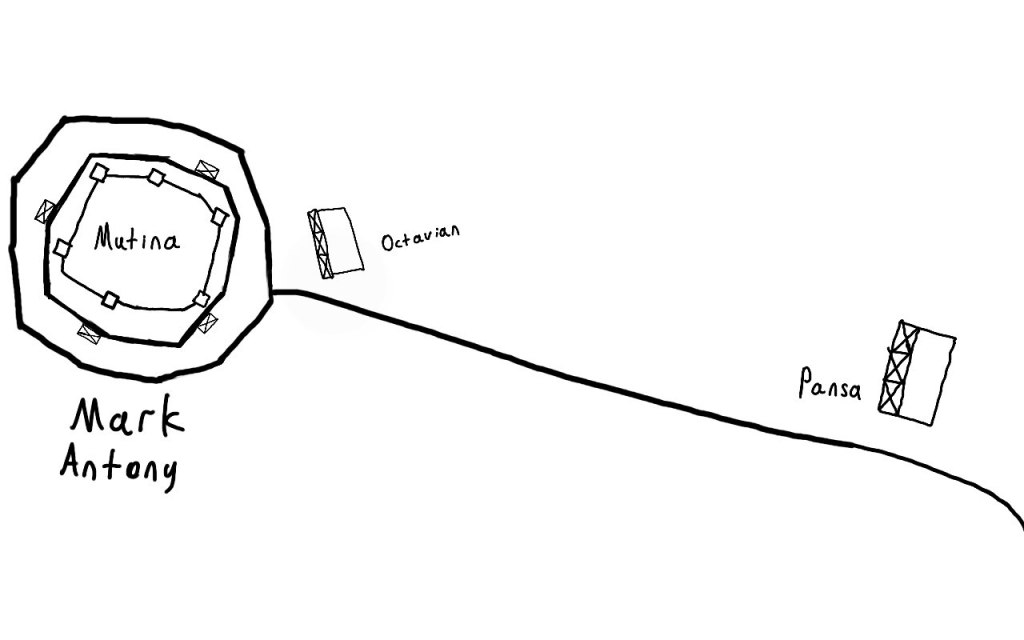
The battle of Mutina took place in 43 BC, between the forces of the 2 consuls Gaius Vibius Pansa, and Aulus Hirtius, which were further supported by Octavian’s forces. Antony, seeking the governorship of Cisalpine Gaul, a province rich in power and resources clashed with the Senate after they refused his request, offering Macedonia instead. Antony refused the offer and marched his legions to northern Italy to confront the governor of the province, Decimus Brutus, who had taken part in the plot against Caesar the year prior. The Senate sent Octavian along with the 2 consuls to relieve Brutus and weaken both Antony and Octavian, hoping this clash would allow them to regain control of the Republic.
Antony encircled Mutina with a wall to cut off supplies and information, and built a second wall around his poisiton, mirroring tactics Caesar had used during his Gallic campaigns during the battle of Alesia. The forces of Pansa clashed with Antony’s troops at the Battle of Forum Gallorum, resulting in heavy losses and Pansa’s mortal wounding. Despite the setback, Antony pressed on, but in the following days, Octavian and Hirtius launched an attack on Antony’s camp, where Hirtius also perished. Octavian then retreated to safety.
The Senate, however, failed to reward Octavian for his efforts, undermining his power and authority. Feeling betrayed, Octavian shifted alliances and joined forces with Antony. This was explained very well by Cicero, perhaps the most influential orator in the history of the Republic, who famously described Octavian’s role, saying that “The young man must be flattered, used, and then pushed aside”. Decimus Brutus, realizing his precarious position, fled to join Cassius and Brutus in the east but was soon captured and killed by Antony’s forces. This shifting of alliances paved the way for the formation of the Second Triumvirate, where Octavian, Antony, and Lepidus would consolidate their power and reshape the future of Rome.
The Second Triumvirate
The Second Triumvirate was an official alliance between Octavian Antony, and Lepidus, established to consolidate power and control over Roman politics. In 43 BC, the Lex Titia (law) granted them extraordinary magistrate positions, with absolute authority that mirrored Caesar’s. This allowed them to divide the provinces among themselves, pass laws without Senate approval, and launch a series of brutal political purges. Their first move was to eliminate their enemies and raise funds through confiscation, targeting around 2,000 people, including 300 senators. A reward of 2,500 drachmae was offered for each head, and among the most notable victims was Cicero, a fierce opponent of Antony in the Senate. His death served as a warning to any who would oppose the triumvirate. Following the proscriptions, Antony took control of Gaul, Lepidus governed Spain, and Octavian, still considered the least experienced of the three, was given the governorship of Africa. With their enemies in Rome dealt with, the triumvirs now turned their attention to Brutus and Cassius, who controlled the eastern provinces. The civil war, sparked by Caesar’s assassination, would soon reach its climax at the Battle of Philippi.
The Battle of Philippi

The Battle of Philippi, fought in 42 BC, marked the climax of the civil war. Taking place in Greece, where Brutus and Cassius were camped, the Liberators, though slightly outnumbered, by 19 to 17 legions, held a strategic advantage. Their superior knowledge of the terrain and control of the area provided them with a stable supply line and a strong defensive position, allowing them to starve out the triumvirs, who struggled with their own supplies.
Octavian and Antony shared command of their army, each leading their respective halves. The battle unfolded in two engagements. Antony initiated the first, ordering his men to charge a weak point in Cassius’ defenses. His forces breached the lines, sacked the camp, and inflicted heavy casualties. Antony had the better engagement, while Octavian’s forces were being overwhelmed, and his camp was pillaged. Neither side gained an immediate advantage, untill the tide turned when Cassius, mistaking Brutus’ cavalry for enemy forces, took his own life (assisted suicide). This dealt a significant blow to the Pompeian faction, which lost one of its last brilliant generals.
Brutus took command of the remaining forces, and the second engagement played out in classic Roman fashion: veteran legions clashing in brutal hand-to-hand combat. Under intense pressure from Octavian’s flank, Brutus’ forces gave ground and were eventually encircled and destroyed. Brutus, realizing all was lost, also took his own life (assisted suicide). The civil war was over, and Caesar was avenged. Yet in Ancient Rome, peace was fragile. With their shared goal of avenging Caesar achieved, the triumvirs’ alliance began to weaken, and Rome once again teetered on the brink of civil war.
Aftermath of Philippi
The treaty of Brundisium, signed in 40 BC divided the Roman world between the Triumvirs. Antony was given control over the east, Octavian the west, and Lepidus was given Africa. After Philippi, Octavian emerged as Antony’s main rival, while Lepidus, sidelined in Africa, became increasingly irrelevant in the power struggle. To further strengthen their alliance, Antony married Octavian’s sister, Octavia.
Antony and Cleopatra

Having command of the East, Antony spent long periods in Alexandria with his lover, Queen Cleopatra of Egypt. Antony relied on Egypt’s resources to supply his planned war against Parthia, while Cleopatra needed Antony to help expand her kingdom to its former glory. Over their 11-year partnership, they had three children together, and although they may have had an Egyptian marriage, it would not have been recognized in Rome, as Roman law forbade marriages with foreigners.
Donations of Alexandria
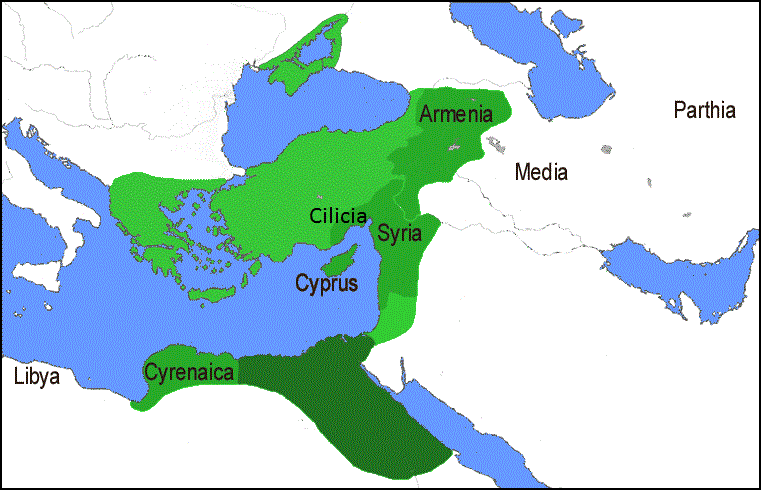
Antony distributed Roman territories among his and Cleopatra’s three children and publicly acknowledged Caesarion as Julius Caesar and Cleopatra’s son. This move directly threatened Octavian’s position, as it undermined his claim to be Caesar’s closest heir. The Donations of Alexandria gave Octavian the perfect opportunity to brand Antony as a traitor to Rome, aligning himself with Egypt rather than the Republic. The Second Triumvirate expired on 33 BC, and would not be renewed. The last civil war of the republic had begun.
Lead Up To Actium
The marriage between Octavia and Antony was a strategic move meant to solidify the alliance between the triumvirs. Octavia served as a mediator between her husband and brother, helping them reach agreements on their respective campaigns. However, despite this, Antony spent much of their marriage in Alexandria, while Octavia remained in Rome. In late 33 BC, Antony formally divorced Octavia to be with Cleopatra, severing the fragile bond that had held the alliance together.
Octavian, always quick to seize an opportunity, obtained Antony’s will and presented it to the Senate—whether authentic or forged by Octavian remains a point of debate. The will revealed that Antony had granted further Roman territories to Cleopatra’s children and expressed his wish to be buried in Egypt alongside her. Seeing this as a threat to the Republic’s future, the Senate declared war on Ptolemaic Egypt, framing it as a war against a foreign kingdom, rather than a civil war.
The Battle of Actium

The stage was set for the decisive battle that would determine the sole ruler of Rome. The naval engagement took place near Actium in 31 BC, in the Ionian Sea. Cleopatra and Antony commanded a formidable force of 500 ships and 70,000 infantry, while Octavian brought 400 smaller, more manoeuvrable ships and 80,000 infantry. Although Octavian was a brilliant politician, his military skills were lacking compared to Antony’s. However, this gap was filled by Marcus Vipsanius Agrippa, Octavian’s childhood friend and a brilliant naval strategist, who played a crucial role in Octavian’s rise to power.
Antony had been encamped near Patrae, awaiting reinforcements, that had wintered in different locations. During this time, Agrippa launched attacks on Greek coastal cities loyal to Antony, disrupting his supply and communication lines, and ultimately forcing Antony to abandon his defensive position.
Trapped on both land and sea due to Agrippa’s prior victories, Antony saw many of his troops and generals desert to Octavian, including Quintus Dellius, who brought Antony’s battle plans with him. With dwindling supplies and options, Antony attempted to break out of the naval blockade. While Octavian initially planned to let them escape and attack from the rear, Agrippa advised a decisive confrontation. It was settled, the battle would be fought then and there.
The battle was fought with far fewer ships than originally anticipated. Desertions left Antony with only 140 of his 500 ships manned, while Octavian deployed 260 galleys. Although Antony’s larger ships were of superior quality—heavier and more powerful—their size made them far less manoeuvrable compared to Octavian’s smaller, agile galleys.
The two sides clashed on September 2nd, 31 BC. As the battle raged through the afternoon, Cleopatra’s Egyptian fleet, which had been waiting in reserve, suddenly retreated toward Egypt. Believing all was lost, Antony abandoned the battle, triggering mass panic and disarray among his troops.
Antony and Cleopatra’s Demise
Defeated at Actium, Antony and Cleopatra retreated to their stronghold in Alexandria, leaving the majority of their army behind. Pursued by Octavian, they faced a month-long siege in July. With no hope left, both Antony and Cleopatra ultimately chose to commit suicide, marking the end of their tumultuous chapter in Roman history.
Sole Ruler of Rome
With his only rival defeated, Octavian emerged as the sole ruler of Rome. It had taken him 16 years to secure his position as Princeps Senatus, the first citizen of the Senate. Learning from Caesar’s mistakes, Octavian wielded absolute power but avoided the appearance of a dictator. In 27 BC, he accepted the title of “Augustus,” meaning majestic, marking the beginning of an empire that would thrive for centuries under the Pax Romana, a period of peace and prosperity that he initiated. The title “Augustus” became synonymous with nobility and greatness, adopted by many emperors who followed in his footsteps. Every time a new emperor was declared, the Senate would wish that they would be “as good as Augustus.” Even today, his legacy endures, with the eighth month of our calendar, August, named in his honor, just as July commemorates Julius Caesar. Their impact on history is undeniable, echoing through time and even shaping the world we live in today.
There was once a dream, a dream called Rome